

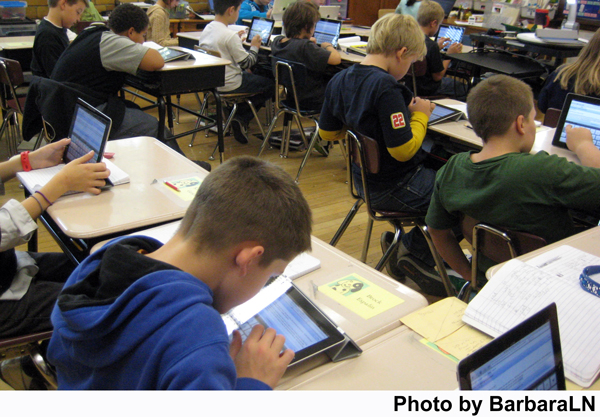
Long connected to schools by offering discounted computers and other equipment to students and teachers, Apple seems to be getting even more intertwined with education—in and out of the classroom.
On Thursday, the tech giant is expected to announce its entry into the textbook market—and this at a time when a day doesn’t seem to go by without a new story about schools buying up batches of iPads.
Now a new study of the education section of the iTunes market shows rapid growth in the pool of apps for the iPad and iPhone that are aimed at younger children.
The study, by the Joan Ganz Cooney Center at the Sesame Workshop, says that in just the last two years, the share of educational apps aimed at preschool and elementary children has grown from less than half to nearly three-quarters of all offerings. Overall, fewer than 20 percent of educational apps are aimed at adults.
Apps are big business, with more than 800,000 available for Apple and Android devices. By 2015, mobile app revenue is expected to top $38 billion.
Since the iPhone was released in 2007, roughly a quarter of all parents have downloaded apps for their children to use, according to the study.
Some more findings:
-the study also found that toddlers and preschoolers are the most popular age-category for children’s apps, representing nearly 60 percent of the total.
-14 percent of educational apps were designed for classroom use.


