


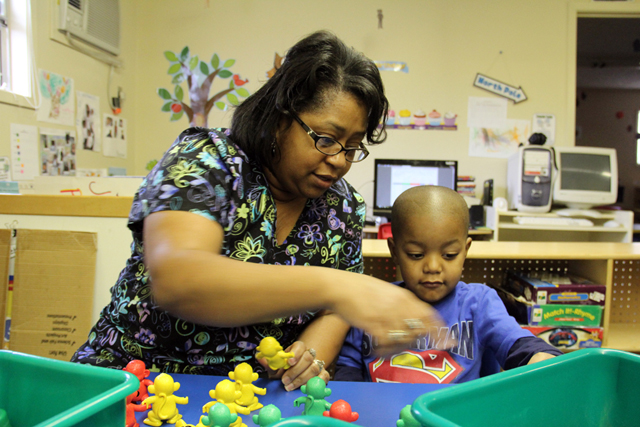
Mississippi is one of only five states in the country to meet all ten quality standards for public preschool, according to a new report by The National Institute for Early Education Research (NIEER). Only one of Louisiana’s three state-funded programs met all the standards.
To determine the quality and availability of state-funded preschool, “The State of Preschool 2016” looked at access to public pre-K, enrollment, and quality benchmarks such as the educational level required of preschool teachers, class size and learning standards for every state, the District of Columbia and Guam. Nearly 1.5 million students in the nation attend state-funded pre-K, although enrollment, funding and quality vary greatly by state. Six states, including Utah, Wyoming and Montana, do not offer public pre-K.
Mississippi has one of the newest public pre-K programs in the country; the state served just 1 percent of 3-year-olds and 4 percent of 4-year-olds in 2016. Nationwide, states serve an average of 5 percent of 3-year-olds and 32 percent of 4-year-olds. Mississippi’s state spending per child was far lower than the national average of $4,976 in 2016, at $1,787 per child, a $6 increase in state spending from 2015. Private individual donors or corporations donated about $1.6 million in additional funds to the state’s pre-K programs last year.
Although the state ranks low on spending and access, Mississippi meets all ten of NIEER’s current quality benchmarks. The state has comprehensive early learning and development standards, requires a BA for public preschool teachers, and the class size for 3- and 4-year-olds is limited to 20 students or less.
Data released by the state Department of Education in January found that kindergarten students who attended public and private pre-K scored higher on average on the state Kindergarten Readiness Assessment than their peers who did not attend pre-K.
You can read the full NIEER report for the nation here, and check out Mississippi’s scorecard here.
This story was produced by The Hechinger Report, a nonprofit, independent news organization focused on inequality and innovation in education. Read more about Mississippi.
Since you made it to the bottom of this article, we have a small favor to ask.

If you believe stories like the one you just finished matter, please consider pitching in what you can. This effort helps ensure our reporting and resources stay free and accessible to everyone—teachers, parents, policymakers—invested in the future of education.
Thank you.
Liz Willen
Editor in chief


I do not understand the emphasis on “top preschool quality,” when the report also says that preschool enrolls only 1 per cent of three-year-olds and 4 percent of four-year-olds -well below the national average. Meeting benchmarks doesn’t mean much if preschool is unavailable to children who need it.
If the state offered just one preschool classroom that met all benchmarks, that would be a high ranking for quality – but should that merit a laudatory headline?